Episode 3: How To Rise in Resilience
As a member of the Misfit Community, you know that uncertainty is the principle challenge your brain faces. Which is why being resilient in the face of uncertainty is essential for you to thrive.
But what enables you to be resilient … ‘to bounce back’? An important question as we emerge from the COVID pandemic. And not just back to where you were. To bounce back better.
How do you Rise in Resilience?
This is the question the Looking Back experiment sought to answer.
Our hypothesis was that, when facing the unknown, not all life purposes would be the same. We posited that some purposes would foster more resilience than others. Why? Because the purpose to which you identify is the driver of your actions, as well as their direction. Knowing the emotional destination of your life provides a sextant by which you can read the constellations for navigating your life’s experiences. If your destination is to sail ‘over there’, then while you might not know what ‘over there’ looks like, you will know when you’re heading in the wrong direction.
In answering this question, hundreds of misfits in our Misfit Community visited our EXPERIMENT page to answer the following question …
“When you’re on your deathbed looking back on your life, what do you want to see?”
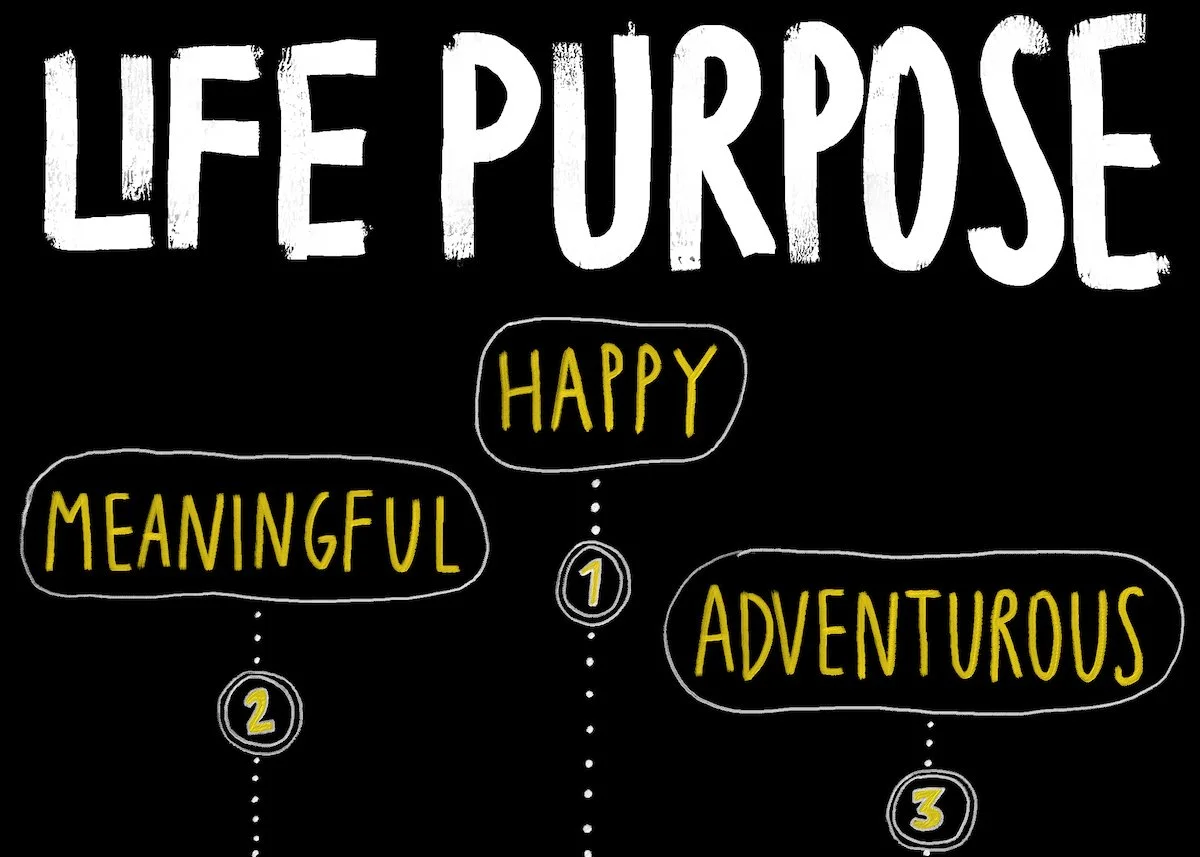
The vast majority of you said that your life’s purpose is to pursue happiness.
And yet for those Misfits, their self-reported happiness in 2020 was lower than Misfits who had said that their life pursuit was different from happiness. Those pursuing happiness were also the most stressed, the most lonely, the most anxious and the least creative.
Which life purpose offered the most to resilience?
Authenticity (as described in the first episode of this series ).
So what does it mean to be truly authentic?
It is not simply ‘to express yourself’ … or to ‘speak your truth’. Self expression is by no means in short supply. Look at Facebook and Instagram. The need for self-expression is the foundation of their success. Nor does simply speaking your truth define authenticity, since your truth is not necessarily the truth. Evidenced those who invaded the US Capital after the most recent presidential election. To be authentic is more. More modest … and far more powerful.
It’s the ongoing exploration of your intentions, words and actions, and their alignment.
Which brings me to the point of this episode: To be aligned.
To understand yourself is not simply to know what you did, when you did it and/or where you did it. It’s to understand why you did it. It’s to understand your internal laws of physics, which are often hidden to your brain. Unlike the laws that govern your external world, your internal laws are specific to you. I call them ‘laws’, not because they are immutable. But because we often act as if they are. How often have you heard or said …
“I could never do that, it’s just not who I am!”
Living within clearly defined “... boundaries” is often espoused by pop-psychology books, self-help gurus and their adherents. But remember that when it comes to perception - which defines who you are, context is everything. Contextual thinking is an essential sign of what we call Perceptual Intelligence. But Perceptual Intelligence is hard, since it requires ‘letting go’ of what you thought to be true before … which might even be what you’d hoped would be an immutable boundary or rule that you could apply to any context.. Its easier to live within immutable walls … by a list of rules … a religion … a recipe … that is imposed upon all contexts.
So be aware of the boundaries you create for yourself (and impose on others) since they can also wall you in order to wall out the uncertainty that necessarily arises from contextual thinking … from applying nuance towards others and doubt towards yourself.
Those who pursue authenticity know that they are not a noun. They are a verb. They have a higher perceptual intelligence. When context changes, they consider the possibility of changing their perceptions, even the ‘boundaries’ that previously defined their identity. But is there a metric for perceptual intelligence?
It’s already within you.
Research has shown that when trying to encourage someone to attend a charity marathon, the sequence of questions matter. If you ask, “Will you attend the charity run this Saturday?”, the number of positive responses is likely to be very high. But the number of those who agreed and attend can be very low indeed. If, however, you first ask: “Are you someone who does what they say they are going to do?”. And when they answer ‘yes’, then you ask: “Will you attend the charity run this Saturday?”, the number of positive responses goes down. But the number of people who said yes and who attended actually goes up. The reason is that their brains have been primed. Their brain’s need for alignment has been triggered.
Coming back to uncertainty, as nearly everything does, when your intentions, words and actions are misaligned, your brain and body feel stressed. Cortisol levels increase with the requisite consequences on your brain, immune system and perceptions that we’ve discussed in previous posts. You experience ‘cognitive dissonance’, not as a function of the world, but as a function of your interaction with it. Often, in these moments, your brain will come up with ‘excuses’ for why it’s misaligned. It’s the ‘fault of others’. Or a fault of the world. Your brain will do almost anything to decrease the uncertainty of itself. To hold onto it’s chosen identity. An identity that for almost every brain is grounded in its own sense of reliability. Indeed, we all have an inherent bias that we tend to be more reliable than average.
Why? because reliability is the foundation of trust. An unreliable person will eventually become a distrusted person … including to oneself.
Think about it …
Who in your life is reliable in action and who is not? You know who they are … those who do what they say (good or bad) vs. those who do not. Those who speak with great words of intentions, but who don’t act on those words. Those who create circumstances in their life in order to escape the effort required to align their intentions, words and actions, but for whom the misalignment is always just beyond their control.
Now … here’s a harder question. Which of these other people is in fact you? Or to phrase the question with more nuance, in which context are you reliable? Is it in loving relationships? In friendships? In work? In your own health? Or is it more subtle … towards a specific person but not towards another. The answer matters. The answer will help reveal you to you. It reveals whether you are aligned in your intentions,. words and actions. It also helps you to know to whom and what you are actually applying your purpose in action. Perceptually Intelligent people want to know. They ask the question and they listen to the answer in themselves (or from those with whom they are interacting). And then they do.
In our experiments, those who selected authenticity as their life’s pursuit also said that their intentions and actions were more aligned in 2020 than did any other purpose. More than this, 50% of those Misfits felt that their intentions and actions were more aligned during the pandemic than before it.
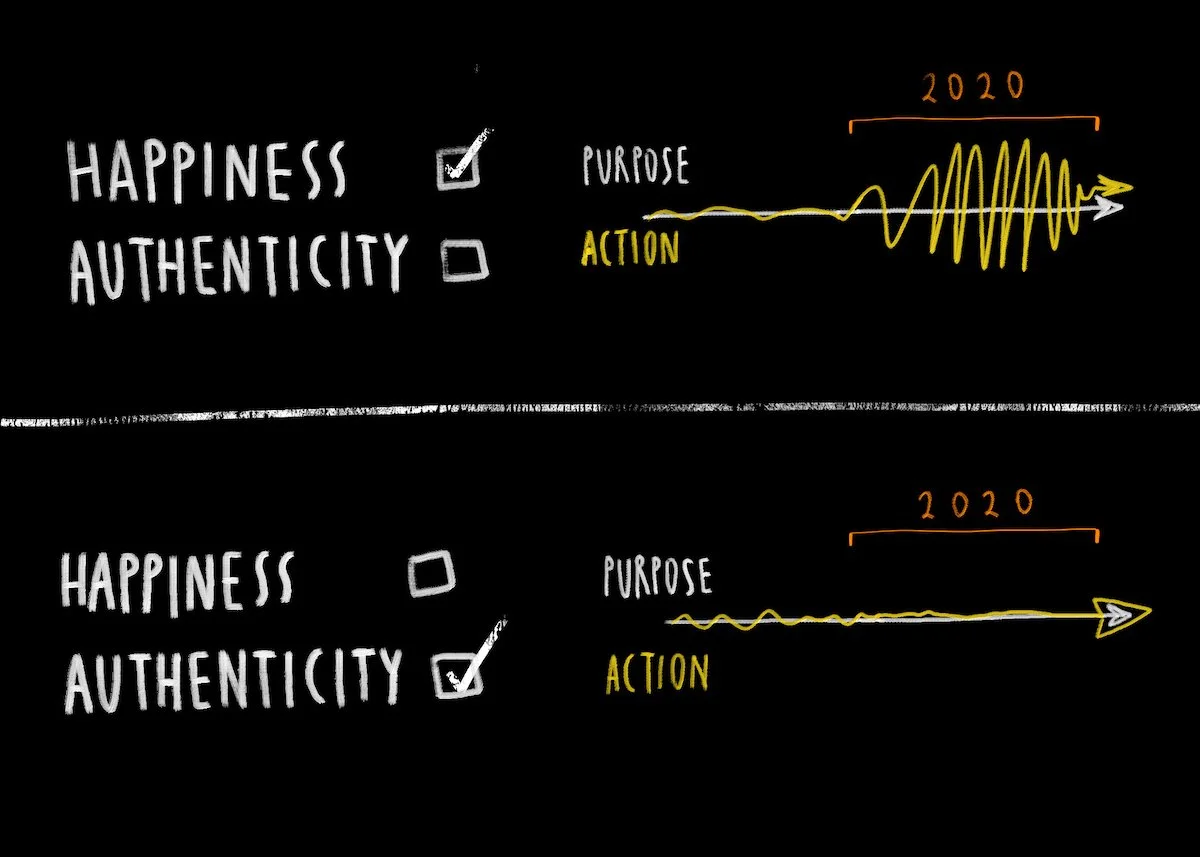
They adapted themselves to uncertainty, enabling them to continue to sail in the direction of their purpose of self-honesty rather than away from it. When aligned, they felt more joy, fulfillment, creativity, achievement and growth in 2020. In contrast, those who selected happiness, wealth or success as their life’s pursuit experienced less alignment between their intentions, words and actions.
So, what ‘kind’ of people are those who pursue authenticity?
Our experiments suggest they are more extraverted, sympathetic and open, less anxious, conventional and reserved. Whereas those in pursuit of happiness are more disorganised and critical, less dependable, reserved and sympathetic. Emotional stability was also important. Those who were most emotionally stable experienced less anxiety, more fulfillment and more growth in 2020. Anxious people felt they behaved less consistently with their life goals, which itself could be a source of their anxiety.
What did we learn from the Looking Back experiment?
Your purpose matters. If you seek happiness, as we all do, don’t pursue it. Devoting yourself to the pursuit of self-honesty, which, when achieved, aligns your intentions, words and actions, is a mechanism for rising in your resilience to uncertainty.