
Episode 5: The Dark Experience: How Contrast Creates Meaning
There is no moment. Now is gone. Wait … there goes another ... and another … each one gone.Which of these moments were you ‘aware’ of in any explicit sense? In some sense, all of them … and in another sense, none.
Many - if not most - of you will be practicing ‘mindfulness’. A key part of mindfulness (but by no means its only part) is to become ‘aware’ of the present. But what if there is no present of which to be aware? What if every moment of every day in your life was nothing more or less than a transition ... unceasing and perpetual?
One could argue - as I have - that there is no way to be ‘in the moment’ in any literal sense. In fact, I’m not actually sure what it means “be in the moment”. I appreciate that this doubt might challenge many who practice mindfulness - and other such strategies for engaging life intentionally. But it need not.
To be sure, to become aware is an essential step in living a more conscious life. Without awareness there is no choice, since there is no choice until you know you have one. What is important is what you become aware of.
Consider the diamond below. You see it spinning. But is it really?
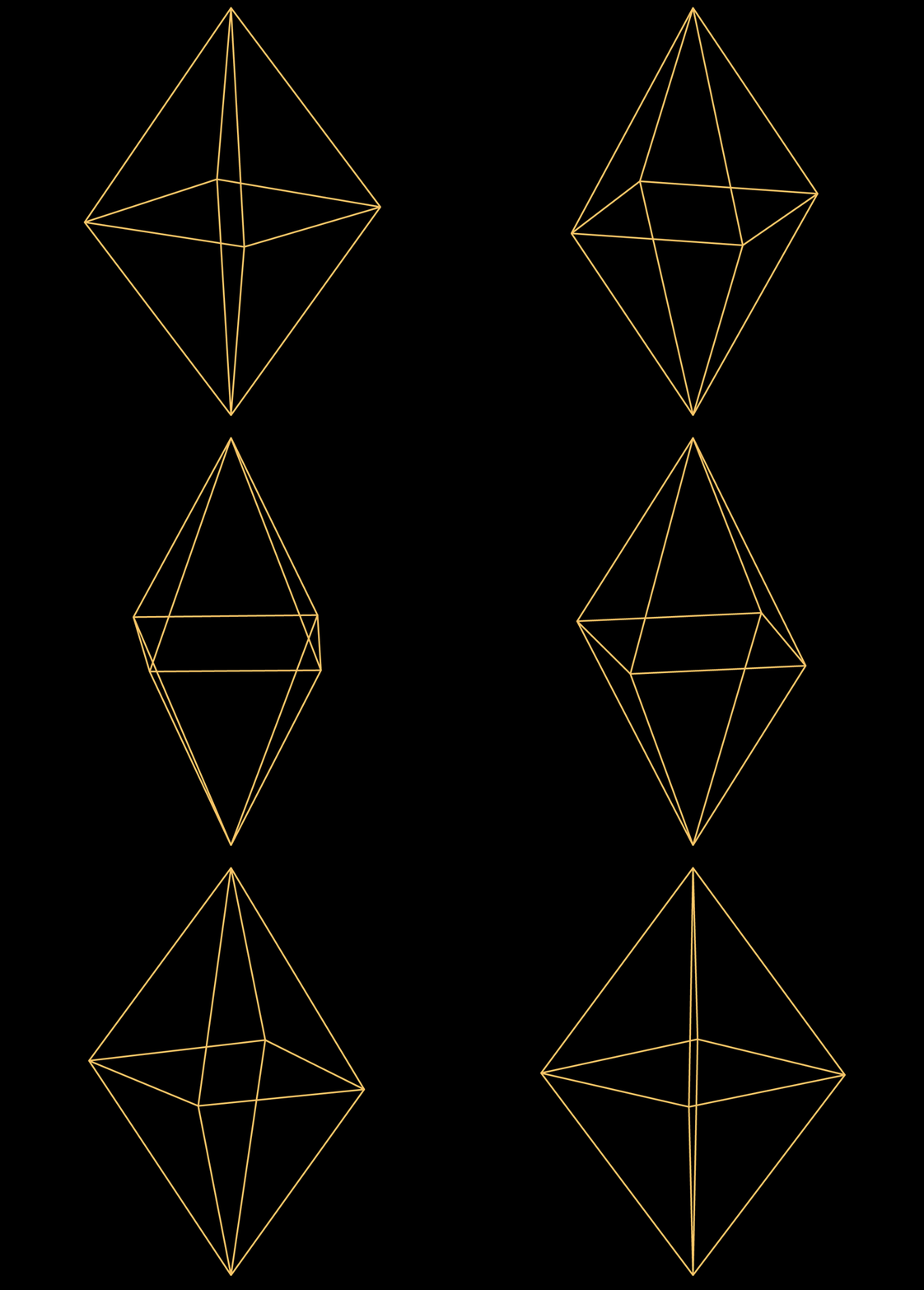
In fact … NO! At least not literally. You’re watching an animation, which is a series of still frames presented in quick succession. Each frame is a moment in time. One following the other. A sequence that creates the perception of ‘phi-motion’ in your brain. Note that - try as you might - it is not possible to become aware of each individual frame … each moment of the spinning diamond. Instead, you were only aware of the transitions between them.
You see, your brain did not evolve to see ‘a moment’ in any literal sense. That’s not possible. Nor would it be wise to do so. Life would be a series of still paintings on the walls in the gallery of your mind. Instead, because your body needs to move - like all living systems, it evolved to see transitions in order to respond to them. More specifically, the meaning of transitions. But where does that meaning come from? In the case of the diamond, the meaning is an expectation of what the lines of the diamond will do next based on your past experience of moving objects in general. Which means that any perceived meaning in the present is necessarily constrained and inseparable from what came before (whether a thousandth of a second before or a thousand years before - in the case of evolution). Perception, then, can not be of any one moment. Instead, your perception - and you - live in the ‘Space Between’ moments. (Hence one of the Lab of Misfits’ favourite T-shirts: BEINBETWEEN.) And that is a beautiful thing in my view.
If true, then this makes strong prediction about what would happen if there were no ‘in between’ … no differences ... no change ... no contrast. Namely, your brain would stop looking.
Here’s an example. Stare as intensely as possible at a spot out in front of you where there is no physical motion. Now, we can all agree that whatever you’re staring at is not moving. Right? Well, it turns out that what seems obviously true is in fact not true. While the spot might not be moving relative to you, your eyes are moving relative to it. How is this possible since you don’t see any movement? The reason is that your eyes are in motion, even when staring fixedly at something. They’re constantly making frequent, small, ‘ballistic’ jitters, which are called saccades and microsaccades. Because of these movements, the light projected from the spot onto your retina at the back of your eye streaks back-and-forth across it.
What would happen if you could stop your saccades and microsaccades? You can find out by closing one eye, and placing your index finger near your tear duct of the open eye. Gently pushing your eyeball to the back of its socket you will literally stop your eye’s involuntary jitters. What happens next? What do you see? In answering this question, remember the light is on and your eyes are open.
NOTHING! You see nothing! The whole visual world, which is full of structure, fades away. Eventually disappearing.
Which brings me to the point of this episode:Without contrast … without change … there is no basis by which to create meaning. Which means there is no possibility for creating perceptions. A moment of lightness does not exist without its contrast to darkness. A cliche to be sure. But that does not make it untrue.
So, what does this have to do with our current Adventure into Sound? The answer: Because my first step into Sound was a step into created contrast. A deviation away from the familiar world of light and noise to a world unlit and unheard. From A to not-A.
Many years ago I was asked by one of the UK’s main television channels (Channel 4) if I would take part in a filmed experience. The experience was to live with a Buddhist monk for 30 days and nights in a completely dark cave in Tibet. As a perceptual neuroscientist who has been strongly influenced by Buddhism (and other Eastern traditions), they wanted me to document the perceptual consequences of being deprived of light and sound for extended periods of time. Sadly the project fell through. My desire to have this experience did not.
Then, last July, many years later, myself and a close friend (who is an expert in yoga practices, meditation and who has had many psychedelic journeys deep within the Peruvian jungle) decided to experiment on ourselves. So we travelled to one of the most beautiful landscapes in Europe in order to NOT see it. Tuscany. Our home was effectively a cement bunker, deep in the forest in the mountains an hour inland from the sea.
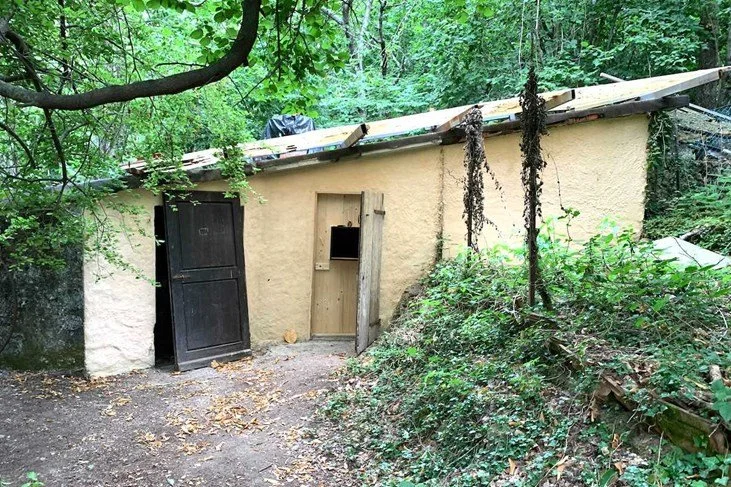
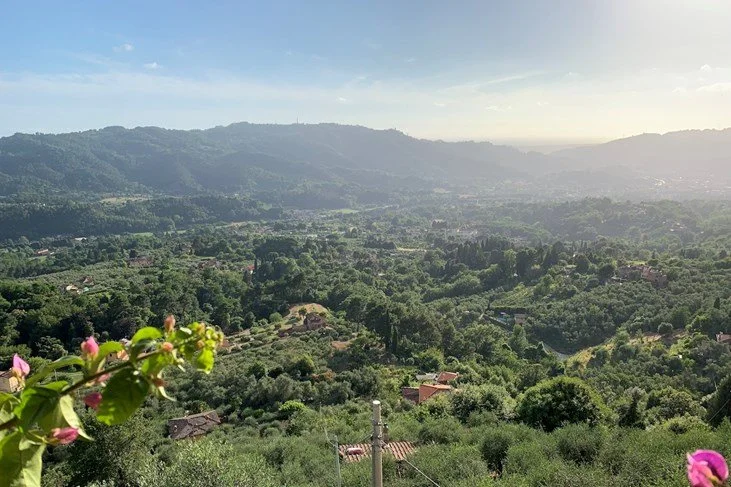
While the views to the distant sea were spectacular, we were there for a different view. One that was much more intimate, and unlit by outside light.
There were two, parallel, rectangular rooms. The larger of the two had a single bed with World War 2 springs … and cement sink. The room measured 4 strides by 3. The second, parallel room was accessed through a narrow opening in the cement wall. It measured 4 strides long by 1 stride wide with a shower at one end and a toilet at the other.
A quick, but important, descriptive note to help create an internal image of the space: By toilet, I mean a wood box with a hinged lid. Inside this lid were two toilet seats. Just below each seat were remarkably normal buckets. The kind you’d buy to mop up a floor. The bucket on the left was for one function. The bucket on the right for another function. In front of this box was a bin of sawdust to aid in composting each.
The rest of the space was equally basic, which we entered just after a beautiful sunset. Once the two doors were shut - to ensure no outside light would invade our experience, we first situated ourselves. Then, after some contemplation, some tilted humour and recognition of the dark days ahead, we blew out the 10 tea-light candles one at a time. When the 10th candle was unlit, the sound was still; The air was still; The darkness was even complete.
You have all had the experience of entering a dark space … or being in a space when the lights suddenly go out. You experience first hand the metaphor of being unable to see the hand in front of your face. But you also know that the blindness will pass. That your eyes and the rest of your brain will adapt to a new low-light normal. There’s reassurance in that learned expectation. You know that in time you will begin to see outlines of darkness set against a darker background. Small lights you’d not noticed before will become visible. Structures and even faces will come into view, enabling you to move with cautious confidence.
Here, the darkness was different. It became a thing in itself. The rods of your retina, which evolved for night-vision as they can detect only a few photons of light, became increasingly sensitive. I could feel their striving … their need for photons. It felt any stray photon would do. The sensitivity of my ears also increased. My skin too. What became increasingly disconcerting is that the darkness didn’t change. The expected returned vision did not return. Blackness persisted. And not at a distance. Right up against your eyes … pressing on them. Creating a feeling of disconcerted alertness. A combination of flight-and-calm. Contrast.
Here we decided to remain for 4 nights and days. The experience was fascinating, as it moved between panic, vulnerability, hallucination and insight … as well as sight! A contrast created through proactive choice.
What was true for this unlit experience is true for every ‘moment’ in my life and yours. Each of our ‘transitions’ has a meaning because each has a history. That history is imbued with effort, fortune, support and randomness. I call it a REMEMBER PRESENT. Since it’s a remembering of the history that led you to where you are right now. It’s what gives your present moment value … its meaning. Might ignoring its lineage disrespect your own journey?
So … be mindful! But be aware not simply of an individual piano’s note in concerto, a single touch of a beloved, the current falling of a single leaf in Autumn in the Northern Hemisphere, or the budding of a single leaf in the Southern. There is also a second, equally essential step in being Mindful, which many either miss or choose not to take part in. It’s to engage with the ‘reasons’ for the moment. The reasons for their existence, since the significance of the RIGHT NOW is founded in the significance of the moment that came before. This is often the hardest part, because it requires contemplating change itself … and the potential of having to let go of the status quo, which can be intwined with past narratives to which we identify but which are no longer valid. But without that engagement, there will be no movement. Just an awareness of a lack of change … without closure.
In the next episode, I will go into more detail about the nature of these dark moments. Until then, be well.