
Episode 4: Wellbeing Requires a Balance of Silence and Noise
For those who have been following these episodes, you’ll know that most of the last two ‘COVID Years’ I’ve been Vagabonding. Adventuring. I’m fascinated by how movement within uncertainty creates us. How it sculpts the functional architecture and resulting perceptions of our brains. My most recent adventure has been into sound ... across Europe.
Sound - like light - shaped the thinking, believing and doing of your ancestors whose genes and perceptions you’ve inherited. They will continue to shape you until the day your body succumbs to the 2nd Law of Thermodynamics. When you too literally become the energy of the very light and sound that shaped you.
The spiral poetry of life.
This is why I study … and write ... about perception. It’s only in knowing that each of us is shaped by our past perceptions that gives us the potential to become active participants in our future perceptions. I call it Perceptual Intelligence and it begins with questioning (and sometimes letting go of) what you thought you knew before.
I’ve been increasingly unknowing for years.
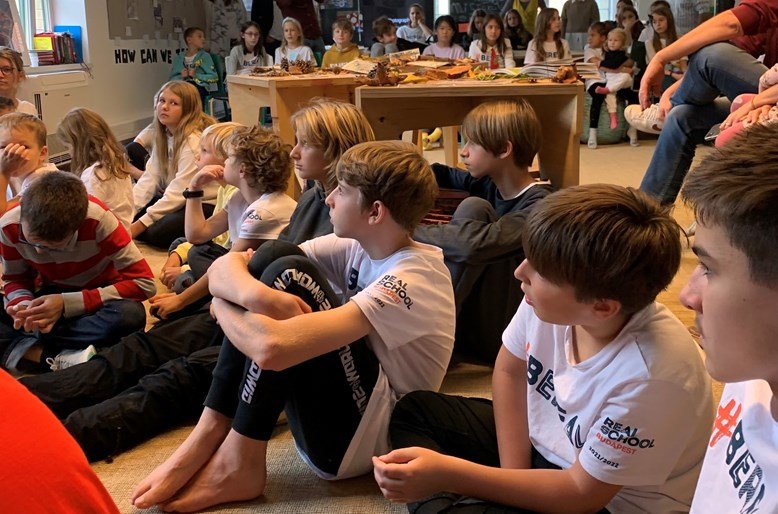
Last week I was traveling to Hungary, where I spend a week each month helping children know less and understand more through our MySFIT Science Programme (created with Dave Strudwick).Its aim is to foster what I call the 7Cs in young people. Courage and Compassion are two of them. Walking through the Schiphol airport outside Amsterdam en route from Ibiza to Budapest, one becomes acutely aware of the intensity and ubiquity of the noise in which we live. The intensity of thousands of people talking and moving within hard, reverberating walls. The amplitude of automated announcements made over the tannoy system loud enough to be heard above the human din, thereby increasing the volume of that din. The noise of ‘background’ music that is meant to sooth emanating from public speakers that compete with the noise of televisions placed in every cafe and sitting area. Then there’s the loudest noise of all: That which is internal, as we increasingly lose the ability to focus on a single thought for more than a few seconds.
Like the rusting of metal, our mental and physical well-being are increasingly being eroded by sound.
The word “noise” comes from Latin meaning queasiness or pain, something Florence Nightingale knew very well. She once wrote that “... unnecessary noise is the most cruel absence of care that can be inflicted on the sick or well”. Every “careless clatter or banal bit of banter can be a source of alarm, distress, and loss of sleep for recovering patients.”
The World Health Organization quantified the effects of noise on the 340 million people living in Western Europe. They concluded that Europeans lose a day of healthy life per person every year because of noise. Even arguing that it was the source of 3,000 heart disease deaths per year (see WHO’s JRC European Commission: Burden of Disease from Environmental Noise 2011). Consistent with this view, Neuroscience has shown that noise activates the amygdala (among other areas of the brain) (see review by Daniel Gross in Nautilus 2014). This neural structure is associated with memory formation and emotion. Its activation causes the stress hormone cortisol to be released, which is one reason why people who live in consistently loud environments often suffer from chronic stress.
In the mid 20th century, epidemiologists discovered correlations between high blood pressure and chronic noise sources like highways and airports (Jarup et al., 2008 v.116 Environ Health Perspective). Later research linked noise to sleep loss, heart disease, and tinnitus. It's from this work that the phrase “noise pollution” came, which refashioned noise as toxic and long-lasting. The most common source of ‘noise pollution’ is commercial and industrial: transportation, construction are examples (see European Environmental Agency’s ‘Manage Exposure to Noise in Europe 2017). Such sources of noise can decrease motivation and increase error making (see New York Times interview with Arline Bronzaft in July 2011, and Bronzaft and McCarthy, 1975 vol. 7 Environment and Behavior).
The functions most strongly affected by noise are reading, attention, memory and problem solving (Hyge et al., 2002 vol. 13 Psychological Science). Children who attend schools in areas that have high levels of environmental noise have lower reading scores and are slower in their development of cognitive and language skills (Hyge et al., 2002 vol. 13 Psychological Science). These children typically develop stress responses that cause them to ignore the ambient sounds. In doing so, they also ignored sounds they should be attending to. Namely, the words of their teacher and peers (Hyge et al., 2002 vol. 13 Psychological Science).
Children can be affected by excessive noise even before birth. In 2004 environmental psychologist Ulrich and Zimmering found that higher noise levels elevated blood pressure of the mother, increased her heart rate and disrupting her sleep patterns, possibly enough to impede development and hearing loss of her still unborn baby (Report to The Center for Health Design for the Designing the 21st Century Hospital Project in 2004 ).
And then there is internal ‘noise’. The interruptions of thought we are increasingly experiencing. These interruptions can have dramatic impacts on performance. A.J. Marsen from Beacon College discovered that they can cause a person to take 27% more time to complete a task, which has up to twice as many errors.
Even the Gods are affected by human noise: According to Mesopotamian legend, they grew so angry at our clamor that they came down from heaven to decimate us … in order to find silence.
Which brings me to the point of this episode:
Silence is essential to human well-being.
It always was. According to Zen Buddhism, enlightenment can only be reached through silence and contemplation.
And yet silence does not exist in any literal sense. In nearly every setting you encounter, there is some form of activity that creates sound. Not only is this true for the external world. It’s also true for your internal world. Our brain is never ‘quiet’. It is always active. One reason is because the brain has two general kinds of neurons. One type is called ‘On Cells’. Another type is called ‘Off Cells’. On-cells respond to the onset of a stimulus, whether it be sound, light or touch. They effectively tell you that something has ‘gone on’ in the world. But when an on-stimulus becomes continuous, the amount of activity of the On-network decreases. You habituate … adapt. By contrast, Off-cells become active only when a stimulus stops, thus signalling that something has ‘gone off’ in the world. And it too becomes less active as the ‘off-stimulus’ becomes increasingly continuous.
So your brain is wired for change, not continuity. Detecting change was essential for our survival during evolution. It enabled your ancestors to react to an attacking predator. And it enables you to distinguish between words in a sentence. It also means that our perception of silence is an active perception. Silence is not the absence of sound and/or the absence of brain activity. Your brain is as active in silence as it is in noise. What is different is the neural networks that are activated.
In 2001, the Neuroscientist Raichle published a paper that defined an interconnected network of brain regions in the prefrontal cortex that has come to be known as the Default Mode Network (DMN). The DMN is constantly gathering and evaluating information. In 2013, Joseph Moran and colleagues wrote the brain’s default mode network “is observed most closely during the psychological task of reflecting on one’s personality and characteristics, rather than on self-recognition, self-concept, or self-esteem. During this time of increased DMN activity activated by silence, your brain integrates external and internal information into “a conscious workspace.” Which means that being free from noise allows your brain to weave itself into the world, to discover where it fits. That’s the power of silence.

This is important. It shows that silence is important not in itself. But as part of a larger experience of the external and internal world. The point is that we don’t need just noise or just silence. What your brain needs is the movement between. Consistent with this hypothesis, studies have shown that too little ‘free time’ decreases well-being. But, then, so did too much free-time. Well-being arises from balance. In this case a balance between too busy and not busy enough. What you need to increase your well-being is an enriched life full of meaningful contrasts.
Many years ago I grew brain cells in a dish. The aim of my research was to discover the molecules that brain cells need to survive and grow. The areas of the brain that focused on were the thalamus and cortex. The thalamus is a walnut-like structure that sits in the middle of your brain. All sensory information from your eyes, ears, skins (but not nose) pass to the thalamus, where it is processed and then sent up to the cerebral cortex - our most recently evolved structures. The cortex is where we and other mammals do our thinking. Primates (and human primates in particular) have the thickest cortices. The cortex is highly plastic, since it wants to match the complexity of its external and internal worlds. The more complex that world, the more these cells need and produce what are called ‘trophic factors’ … molecules like Brain Derived Neurotrophic Factor (BDNS) that promotes brain-cell growth. The less complex its world, the less these molecules are produced.
Which means that silence is important exactly because it is a component of an overall enriched environment. Too much noise and your brain feels stressed. Too much silence and it has no purpose. Thus, two hours of silence per day (in mice) within a larger context of environmental activity prompted new cell genesis (Kirste et al. 2015 vol. 220 Brain Structure Function).
Creating an enriched experience of sound … of people … of light … of ideas … grows your brain!
Which is why my first step in my adventure into sound was not into sound. But away from it. I adventured to one of the most beautiful places in the world … Tuscany … in order not to see it. For 4 days and nights I was in the mountains in silence … and in complete darkness. The experience was remarkable, which I’ll tell in the next episode.